The Silent Strength of the Dolgans in a Warming Arctic

Mahacaraka® Press
Across the remote Taimyr Peninsula in northern Siberia, beyond the reach of roads and the rhythm of city life, the Dolgan people continue to endure. With a population estimated at just over 7,000, according to the 2021 Russian census, they are one of the smallest Indigenous groups in the Russian Federation. Yet their cultural resilience speaks volumes in a region defined by permafrost, isolation and decades of political upheaval. Their way of life is shaped not only by the tundra but also by the shifting tides of modern Russia and global climate change.
Historically, the Dolgans are a relatively recent ethnic formation, emerging as a distinct group in the 19th century. Their ancestry includes Evenks, Yakuts, and Russian peasants, with cultural and linguistic influences shaped by centuries of migration, trade and adaptation. They speak the Dolgan language, which is closely related to Sakha (Yakut), a Turkic language still spoken by many Dolgans today, although Russian has increasingly dominated official and educational use since Soviet times.
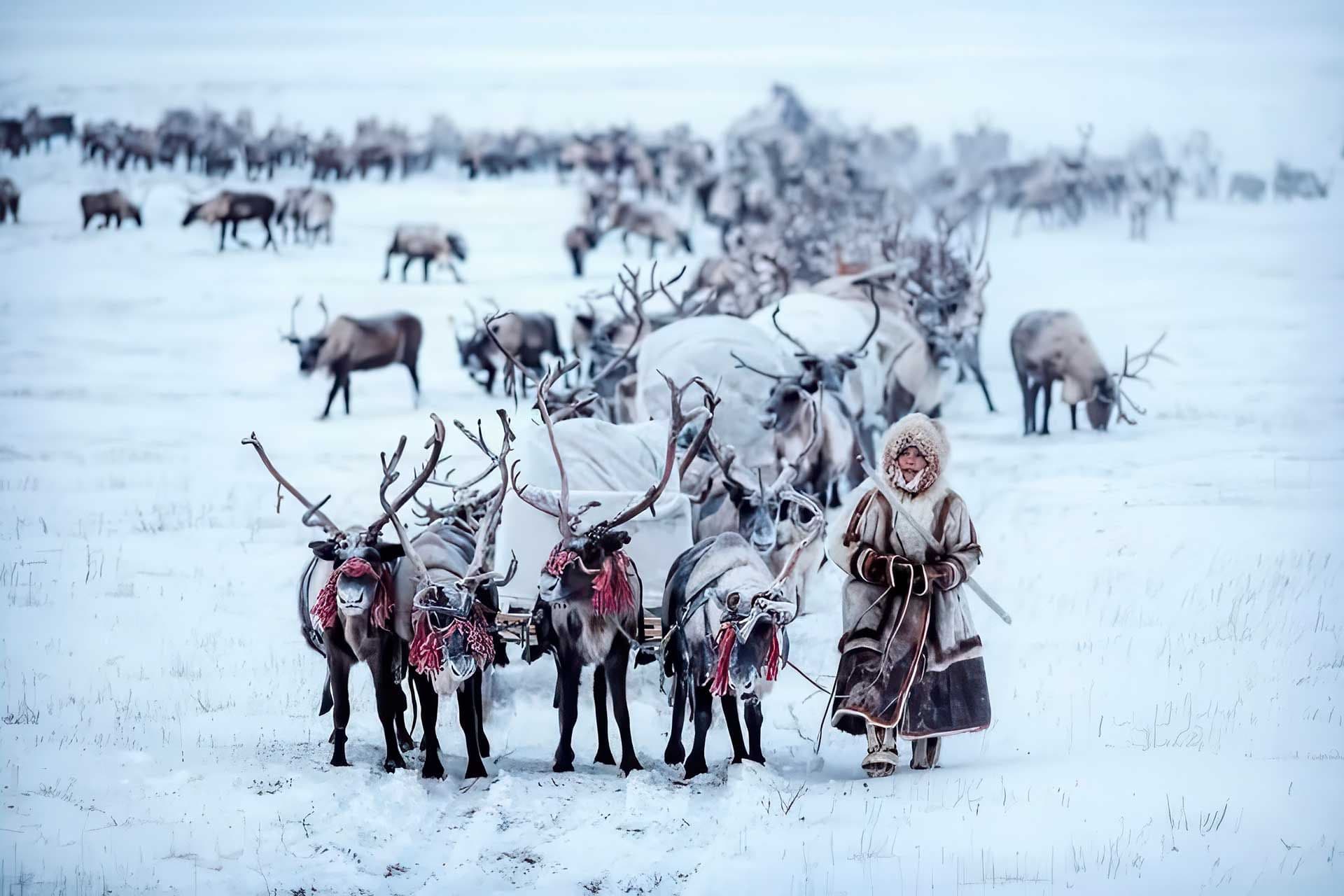
Their homeland spans one of the coldest inhabited places on Earth. Winters on the Taimyr Peninsula can plunge to -60°C, and daylight vanishes for weeks during the polar night. Yet in this harsh environment, the Dolgans have mastered the rhythms of nature. Reindeer herding forms the backbone of their traditional economy, providing not only transport but also clothing, meat, and trade. In addition to reindeer, they hunt wild animals such as arctic fox, ptarmigan, and occasionally polar bear, and they fish in the frigid rivers and lakes scattered across the tundra.

A defining feature of Dolgan culture is their nomadism, although this has undergone dramatic change in the last century. Under Soviet policies in the 20th century, many Dolgan families were forcibly settled in collective farms known as kolkhozy. While these policies disrupted traditional lifeways, they also introduced education, healthcare, and basic infrastructure to some communities. Today, while some Dolgan families continue to migrate seasonally with their herds, many others live in villages such as Dudinka, Khatanga, or Ust-Avam.
The struggle to maintain traditional knowledge while adapting to a modernising world is ongoing. Schools in Dolgan areas mostly use Russian as the primary language of instruction, and many young Dolgans leave their villages for cities in search of work, education or modern comforts. This has led to a decline in language use and transmission of oral traditions, such as storytelling, shamanic beliefs and ancestral songs. Cultural revival projects have emerged in recent years, including Dolgan-language textbooks and local festivals aimed at celebrating and preserving Indigenous identity.
Climate change has introduced another layer of uncertainty. Rising temperatures have begun to alter migration routes, thaw permafrost, and affect wildlife patterns that herders and hunters depend on. Reindeer, sensitive to weather shifts, have become harder to manage. Melting permafrost threatens not just the land but the very foundations of village homes and sacred sites. Some researchers have warned that the Arctic is warming four times faster than the global average, placing communities like the Dolgans at heightened risk.

Despite these challenges, adaptation is not new to the Dolgan people. Their history is marked by cultural blending, mobility and resilience. Some herding families have begun using snowmobiles alongside sleds, smartphones to track weather or communicate between camps, and satellite internet to connect with wider networks. Elders play a crucial role in cultural continuity, passing down knowledge of land, medicine, and cosmology even as external pressures mount.
Craftwork remains a vital expression of identity. Dolgan women are known for their fur sewing, beadwork and embroidery, often incorporating symbolic motifs drawn from nature and spiritual beliefs. These traditions are not merely decorative but serve as historical records, encoding relationships with animals, land and ancestry. In some communities, workshops have been established to teach younger generations these skills, not just for preservation but also as a potential source of economic empowerment through tourism and online sales.
The legal framework for Indigenous rights in Russia offers limited protection. While the Dolgans are officially recognised as one of the “Small Indigenous Peoples of the North,” and are granted certain cultural and land use protections on paper, implementation remains inconsistent. Extractive industries such as nickel mining and oil drilling have disrupted traditional territories and brought environmental degradation, often without full consultation or consent.
However, alliances with other Indigenous groups across the Russian Arctic have fostered solidarity. Conferences, environmental activism and digital platforms have given Dolgan voices greater visibility, albeit within a complex political landscape. The rise of pan-Arctic identity, bolstered by organisations like the Russian Association of Indigenous Peoples of the North (RAIPON), has provided a forum to address shared challenges.
For outsiders, the Dolgans may seem like a people suspended in time, navigating between sled tracks and satellite signals. Yet this is a false dichotomy. Their culture is not static but evolving, negotiating the pressures of assimilation, modernity and survival. Like the reindeer herds they guide across the snowbound plains, the Dolgans are in constant motion — not backward or forward, but onward, tracing a path carved by generations before them, and kept alive by those who refuse to forget.
Their story is not one of disappearance, but of endurance.