The Journey That Proved the World Was One

Mahacaraka® Press
In the early decades of the 16th century, as empires strained against the boundaries of known maps, one man dared to seek a new passage across the oceans. Ferdinand Magellan, born around 1480 in northern Portugal, would go on to lead the first expedition to circumnavigate the globe — a feat that would transform Europe’s understanding of the world and solidify his place among the most consequential navigators in history.
Raised in a noble family, Magellan entered royal service as a page at the Portuguese court, where he was exposed to maritime navigation and the imperial ambitions of his homeland. Portugal, at the time, was rapidly expanding its influence across Africa and Asia, propelled by the explorations of figures like Vasco da Gama. Magellan's early naval career took him to the East Indies, where he gained valuable experience in navigation and military engagement. His participation in the conquest of Malacca in 1511 would later shape his strategic outlook.
A dispute with the Portuguese crown, however, left him sidelined and disillusioned. Denied recognition and further command, he renounced his allegiance to Portugal and turned instead to the Spanish court. There, in 1518, he persuaded King Charles I (later Charles V of the Holy Roman Empire) to sponsor a westward expedition to reach the Spice Islands — today known as the Maluku Islands in Indonesia — by sailing around South America. This route, he argued, would offer Spain access to the lucrative spice trade without infringing on Portuguese claims in the East, as outlined in the 1494 Treaty of Tordesillas.
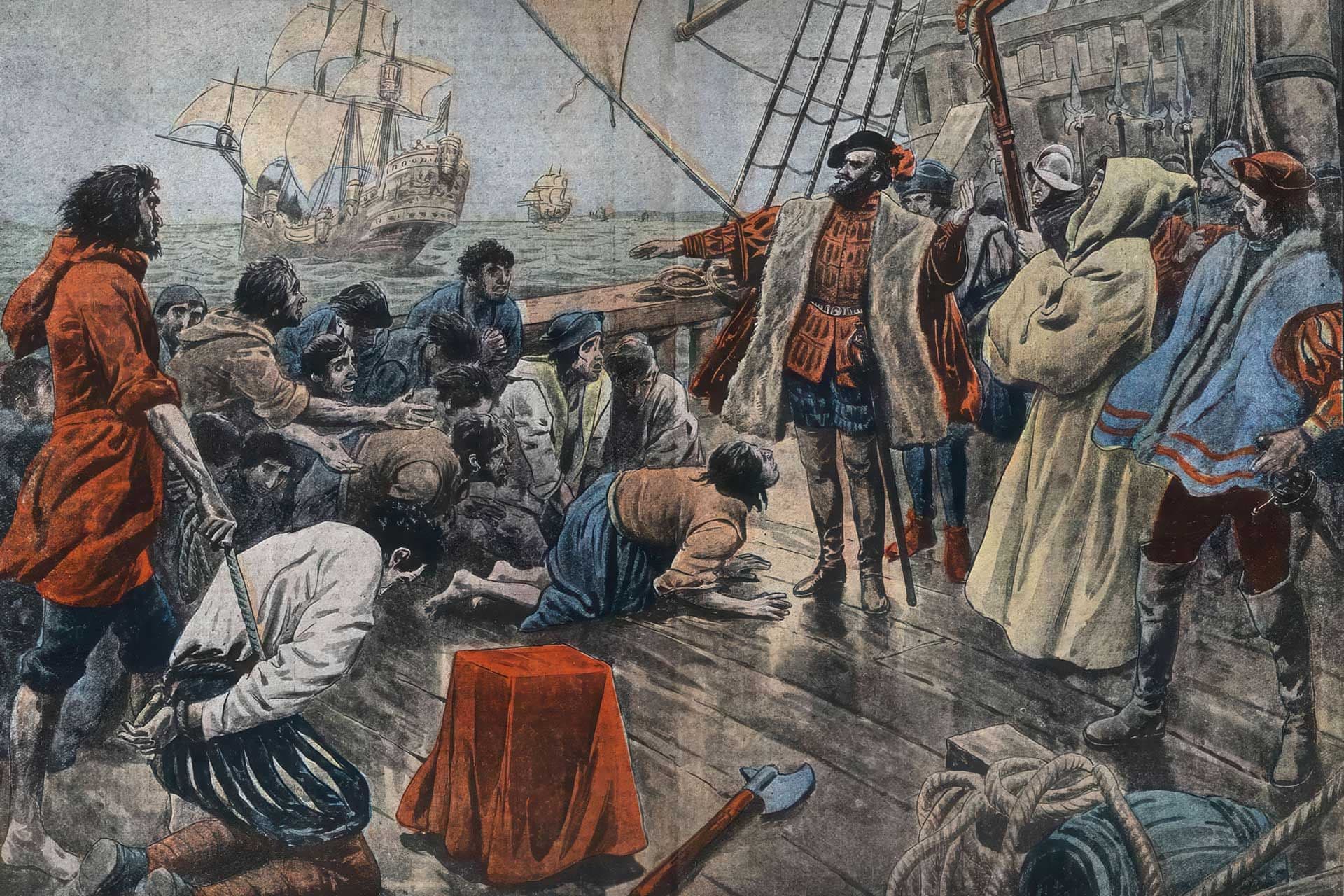
On 20 September 1519, a fleet of five ships set sail from Seville: the Trinidad, San Antonio, Concepción, Victoria and Santiago. Magellan, though technically subordinate to Spanish officers, held full command. The voyage was fraught with adversity from the outset. Storms, crew mutinies, and treacherous waters challenged the fleet as it navigated down the coast of South America. At Puerto San Julián in modern-day Argentina, one of the darkest chapters unfolded: a mutiny by Spanish captains, which Magellan crushed decisively, executing or imprisoning the ringleaders.
After months of searching, the fleet discovered a narrow strait near the southern tip of the continent — now named the Strait of Magellan — in October 1520. The passage was perilous and claimed the Santiago, which was wrecked during a reconnaissance mission. Nonetheless, it provided a long-sought route from the Atlantic to the Pacific, a sea so vast that Magellan named it the “Mar Pacifico” for its deceptive calmness.
Crossing the Pacific proved an ordeal. For over three months, the ships encountered no inhabited lands, and the crews suffered from starvation and scurvy. Many died, and discipline eroded. Yet Magellan pressed on. In March 1521, they finally reached the Philippines, where they found fresh provisions and local societies engaged in complex regional politics.
Here, fate turned. In an attempt to support a local ruler allied with the Spanish crown, Magellan involved himself in a conflict on the island of Mactan. On 27 April 1521, he was killed in battle by warriors led by Datu Lapu-Lapu, making him one of the earliest Europeans to die in the Philippines. His body was never recovered.
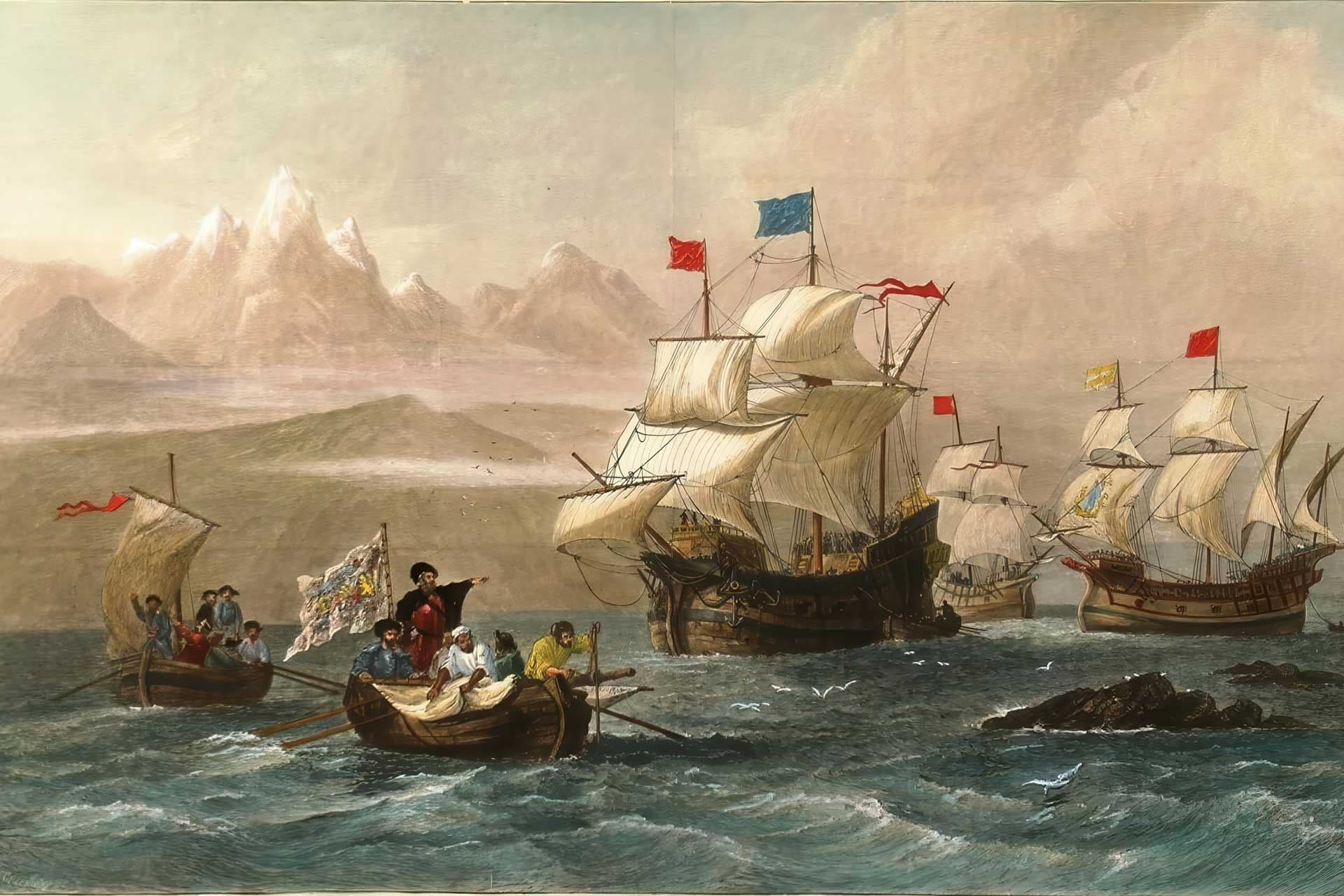
Though he did not live to see the voyage completed, his legacy would be carried forward by Juan Sebastián Elcano, who took command of the remaining crew. On 6 September 1522, the Victoria returned to Spain with just 18 of the original 270 men, completing the first circumnavigation of the globe. The feat proved beyond doubt that the Earth was round and that the world's oceans were interconnected.
The impact of Magellan's expedition rippled far beyond geographical discovery. It reshaped global trade routes, undermined older worldviews, and initiated a new phase of Spanish colonial expansion in Asia. The circumnavigation also revealed the vast scale of the Pacific, correcting European underestimations and demonstrating that reaching Asia via the west was not as practical as once thought.
Despite his controversial decisions, Magellan’s strategic vision and navigational daring remain central to his enduring legacy. He understood, more than most of his time, that exploration was not simply a matter of charting coastlines but of redefining global understanding. His name is etched into maps, straits, celestial craters and even spacecraft, a reflection of the lasting impact of his journey.
Modern reassessments of his story often confront the dual nature of his legacy — as both a visionary navigator and a participant in the early mechanics of empire and colonisation. The expedition brought with it violence, imposition of foreign rule, and exploitation of local populations. These aspects are increasingly acknowledged in contemporary historical narratives.
Nonetheless, the circumnavigation of the Earth remains one of humanity’s most extraordinary achievements. It required not only courage and endurance, but also relentless curiosity about what lay beyond the known. Magellan may not have returned, but his voyage changed the shape of the world — not just on paper, but in the minds of those who followed.
To study his life is to examine the very essence of the Age of Exploration: a time when ambition, rivalry, and the thirst for knowledge launched sails into the unknown.